TECHNOLOGIES AND PROCESSES
Our processes for your quality – intelligent, precise, automated.
Automated materials testing with state-of-the-art technology
At STALVOSS Automation, we use state-of-the-art methods of non-destructive material testing to automatically capture material properties, surface conditions, and structural integrity. Each testing module is precisely tailored to your production processes – flexibly integrable
Flawless components – made visible.
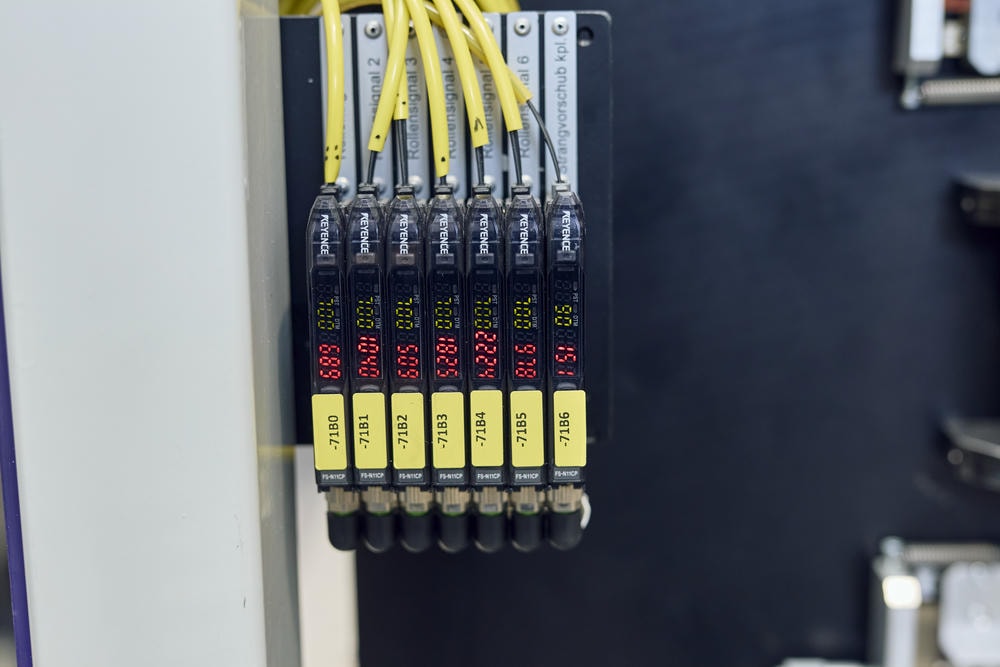
Using high-resolution camera and lighting technology, our systems inspect lateral and end surfaces as well as edges for visual deviations. We detect the finest scratches, notches, discolorations, or geometric irregularities that allow conclusions to be drawn about quality. Surface inspection is often the first step in the automated testing process and is crucial for your delivery quality.
Typical use cases:
- Lateral and end surface inspection
- Edge inspection
- Brightness and color deviations
Reliably detecting defects in depth.
Not every defect is on the surface – that is why we combine visual methods with proven eddy current technology to identify micro-cracks, structural changes, or structural defects. Our systems thus enable early detection of safety-relevant material defects – inline and without loss of cycle time.
The processes operate contact-free and are just as suitable for rotationally symmetrical components such as rings or shafts as they are for complex custom parts.
Technological reliability through in-depth analysis.
Testing material hardness and composition is essential for many industries – especially for high-load or safety-critical components. Our automated systems check contact-free and precisely whether the material properties are within the required range. Grinding burn, hardness deviations, or alloy defects are reliably detected and documented.
Possible methods:
- Hardness testing according to UCI, Rockwell, or customer-specific standards
- Material analysis via material parameters
- Inspection for thermal changes (e.g., grinding burn)
Reliable against deviations – before failure occurs.
Our corrosion testing systems detect not only the onset of rust but also other gradual losses in quality such as fit errors, deformations, or dimensional deviations. In combination with other testing modules, they ensure that every component meets the exact specified requirements – without compromise.
These quality controls can be integrated into several process stages, e.g., directly after machining or before packaging.
Fully automated separation of what does not belong in the series.
After the test comes the decision: Is the part okay – or not? Our intelligent sorting systems make this decision in milliseconds and control the component’s further path. Accepted parts are passed on for further processing, while defective parts are automatically rejected. Integration with downstream processes, warehouses, or traceability systems is seamless.
Advantages of automated rejection:
- Reproducible, documented decisions
- Connection to production and ERP systems
- Traceability via ID, DMC, or RFID